

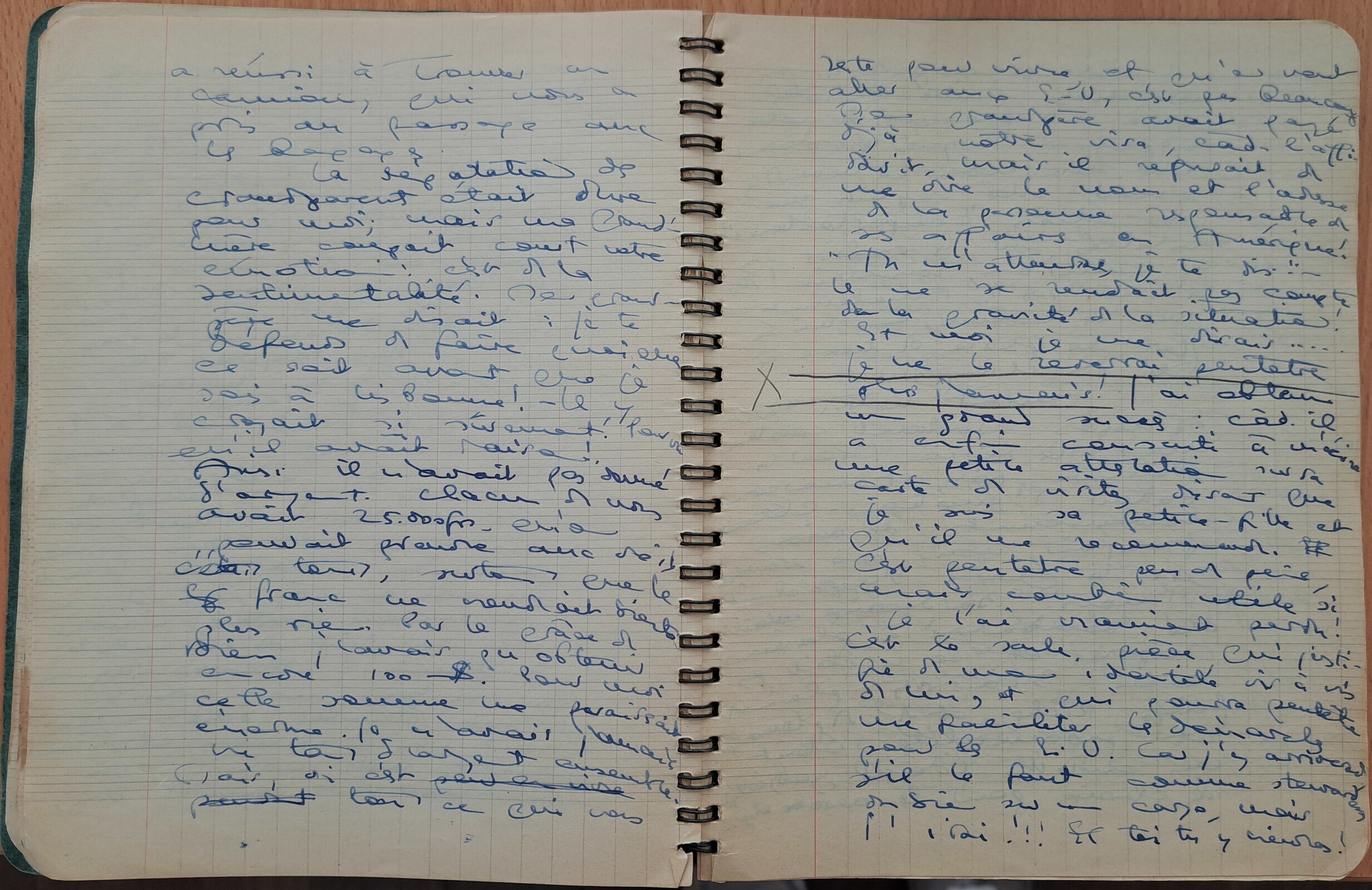
Adèle Van Den Bergh's Diary
Diary on Board
Address of the Captain of the Milena
António Francisco Coruja [Cereja?]
Ílhavo, Portugal
On board the Milena
Saturday, 22nd June 1940, 5 p.m.
My dear,
The adventure has begun, scented with the smell of steam smoke and Portuguese sardines.
We should have left yesterday, but the sardines had not yet been unloaded. Rumours: we are leaving - we are not leaving – tonight - tomorrow. During [the past] two days, everyone has [had] something to say; they are frightened and frighten each other. I remain calm, why shouldn't I? I know that we shall leave soon, that is the essential thing. One member of our group, Mr de Kadt, ingenious as ever, organised the entire operation.
It was he who, three weeks ago, sought out a shipping broker and asked him whether he could find a boat. The man in question laughed in his face. Why would he want to leave? It would be madness; there was no danger whatsoever. This was three weeks before the betrayal by the King of the Belgians... Nevertheless, de Kadt kept in touch with this broker, and undoubtedly did the right thing.
A few days ago, he went in search of the guy who had told him about this sardine fishing boat, which was due to arrive the following evening – two or three days ago now. The great family council then deliberated at length, and we agreed to explore the possibility of chartering or even purchasing the vessel. Much discussion, little decision... and time was running short.
During those anxious days, I had rationally prepared my luggage. I bought a rucksack in case walking became necessary. I carried a large handbag, a small suitcase inside a larger one, and all sorts of things I did not strictly need. In every case there were shoes, clothes and underwear, so that I would always have something to wear should I lose one of my suitcases.
I had set aside the small items I might need even in the event of...... Everything had been carefully planned. On the day I learned of the possibility of travelling on this boat, dirty and devoid of comfort, I took out my skiing clothes, woollen socks and sleeping bag so that I would not be cold when lying down beneath the beautiful stars. I bought waterproof fabric in which to wrap my passport and valuables. I sewed an identity document and a small sum of money into my corset so that I would always have them with me, even in the event of a shipwreck... I had already sent copies of some of my documents to the United States, to my uncle's home.
I bought a stainless steel torch, elastic straps to make bundles, small collapsible water containers, and all sorts of practical and indispensable items that everyone envies me for today......
I am the only person practically dressed already in my ski trousers and waterproof jacket. I bought rope-soled sailors' shoes, so I can sit or lie on the deck without getting dirty.
During the past few days, since the boat project began to take more definite shape, I regained my composure. At night I often could not sleep, and I would jot down in a small notebook everything that still needed to be done.....
Santander
Wednesday, 26 June 1940, 2.30 p.m.
My dear Amissimo!
It has been a long time since I last wrote to you. It isn't the same when I can send you a letter or when I do not even know whether you will ever read what I am writing now.
So much has happened to me during the last few days. I shall tell you everything. I have plenty of time, what I lack is being alone with you, so that I may calmly gather my thoughts and feelings. I am lying on deck in the sunshine, which is smiling upon us at this moment.
I think of you and long for you so much and ask so much of you, my Amissimo. Why are you not with me on this historic journey?
We have gone through so much and perhaps we still have much more to face. How shall I tell you everything? You must know exactly what it has been like for your Adichka.
On the evening of 19th June it was finally decided that we would leave. The following day my grandmother was to go shopping with me. Provisions for fifty people, for at least four days. She even wanted to buy chamber pots for everyone! True luxury aboard the sardine boat. With difficulty we managed to find a taxi to take us to Bayonne. Our chauffeur did not have his safe passage pass. Bayonne was dreadful! It was crammed with cars full of refugees, driving was impossible, everything was sold out, most shops were closed. This was truly the first time I saw anything of the war at first hand!
Nothing whatsoever could be bought. The town was sold out and practically cleared out. Apart from that, I had never, whether in La Baule, Nice or Biarritz, experienced an air raid siren; there was always food to eat, and only the blackout occasionally reminded us that we were at war. Even then, that was possible only in France, where the present drama affected all forms of work ------, whether ordinary labour or men's work.
Moreover, it was impossible to find provisions anywhere. So I looked for a ship’s provisions shop and during our 4-hour drive, we were caught in the most terrible thunderstorm I have ever experienced! The entire sky was brilliantly illuminated, everything turned dark as night, and the lights went out. Unfortunately, the taxi was not waterproof either. Water came in everywhere.
But in those last days I had experienced so much and endured such fear that the Germans might be approaching that the storm scarcely impressed me. When we reached a café where we could wait peacefully, all was well. Meanwhile I learned that the boatman had apparently already settled everything and that we could quietly return home. "Quietly" was somewhat of an exaggeration. The town was so crowded that we could barely make our way through, and it took a long time to return to Biarritz.
We still hoped to be able to leave by boat that night, but unfortunately it proved impossible. Each person had to pay $125 and 5,000 francs, which was not expensive considering our destination. An especially unpleasant surprise awaited all of us, and me in particular. My grandfather informed us that he and the other older members of the family, my grandmother, two uncles and a wife, were too old for such a voyage. In general, he remained remarkably optimistic. He would travel overland and calmly await his visa. The young people, Simon, Sonia, Tamara, Max and Netty van den Bergh [and I], who were so frightened, could go; the others would travel by land.
We begged Grandfather to be sensible. He could not sacrifice himself for his elderly and ailing brother. What nonsense! He rebuked us sharply, saying we were exaggerating and that he would not go, full stop!! And now we fear so much for them all. As of today, the Germans have occupied the entire coast to the Spanish border. Did they manage to get through in time? Until the very last day, they went out for walks as though nothing had happened. We were all trembling with fear.
Grandfather was, in a sense, the moral leader of our group and, for that reason, the others were unhappy that he was not coming with us. Some even declared that they no longer wished to go because they lacked his moral support.
We had no visas for Portugal and Grandfather had arranged with the envoy in Lisbon that he would obtain them for us. Now he was not accompanying us and perhaps we would encounter difficulties? Everyone was deeply agitated; I was especially saddened!
Having already lost my parents, I was now losing my grandparents too, after we had spent the entire war period together and shared all our personal worries. And in addition, my fiancé, my Amissimo, was so far away. When would I see him again? Yet I was convinced that I would see him soon! All the while I have felt as though I have lost everyone: my own family in the Netherlands, in Belgium, now in France; perhaps Saps too will never be found again, nor her children. But I shall find you again. Of that I am certain!
Just as good fortune accompanied me onto the Milena and enabled me to pass through despite the storm and the Spanish officials, so too shall I find you. Perhaps in weeks, months, years, but in any case......
Thursday evening, 8 p.m.
Somewhere in Spanish waters
There we are, sailing once more. This time there is plenty of wind from the right direction and our four sails are doing their work well. I told the Captain that if he brought us safely to port, my daughter would bear the name Milena, and that I would send him a letter to tell him so. He then asked me where my fiancé was. "In the seventh heaven," I replied. "Then we cannot have a child." How does this Captain know such things! And my fiancé? Where is he really? In France, Italy, Germany, or somewhere else?
This evening is so beautiful. I wish you were with me to enjoy it. How wonderful the world is! The Basque coast, the sea, and yet so much misery in the world. So many unhappy people everywhere. I read in a Spanish newspaper that all evacuees in France had to return home, leaving behind everything they carried with them. That was what I expected for the others as well, whether in the Netherlands or Poland. And just as I did not wish to live in the Netherlands without Hitler, even less did I wish to live there with Hitler.
I am sitting in the captain's cabin, but I do not feel well and go outside for fresh air. It is the only way to avoid seasickness.
See you later, my dear boy, oh -----!
Friday, 28 June, 7.30 p.m.
Last night I became very ill, with dizziness and the like, and went to bed early. This morning I remained lying down almost until midday. My "bed" is on the floorboards. I sleep in my sleeping bag and, for the past two nights, I have enjoyed the luxury of an inflatable mattress, it is delightful! The others sleep in deckchairs. I much prefer my improvised bed. It is somewhat hard, but I sleep very well. The sea air tires me enormously, and it provides a wonderful escape when one wishes to forget one's worries for a while... and they are many. The grandparents! Where are they? My Amissimo, when shall I see you? Yet I wish to think of these things with optimism, with a certain carefree dolce far niente while it is still possible. Troubles are for tomorrow. Let us therefore make the most of today.
I have a sleeping compartment entirely to myself! That seems extraordinary on a boat carrying so many people! But to reach it one must crawl along the floor through a sort of tunnel, and no one seems to have discovered it. I have spread out all my clothes and belongings on a plank and enjoy my solitude, certain that no one will disturb my things. I hear the others snoring in the distance, but it does not bother me. I sleep the sleep of the righteous! And I am alone. That is what matters and I feel that there are two of us, and thus I bear my fate more easily. So think of this, my dear: if I have lost my grandparents, I have only you left in the world!
Moreover, I am practically penniless, for my grandfather was so certain he would arrive in Lisbon that he did not wish to give me any money! I believe I shall find someone who will finance my journey to America, where I shall find work. I have never feared being unable to manage. Long ago I prepared myself for the possibility of becoming a refugee. I have often told you: my grandfather may lose all his money. But what is in my mind is mine! And you have your voice! There is our capital, for both of us, and it is more than enough.
Two things frighten me. First, that Greece may enter the war, which depends on Russia. Second, that you may be called up to march. As long as you remain "neutral", I am certain I shall see you soon. Another thing I fear is that England may be defeated and that they may turn towards America and, aided by the Fifth Column, bring about the worst! If Hitler or his gangsters should ever lay their hands on me, I shall be sent back to the Netherlands or Poland, and then how shall I ever find you? The day we share the same nationality, I shall no longer be afraid. Whatever happens to you will happen to me as well, and that does not matter so long as we are together!
"Geteiltes Leid ist halbes Leid." (Shared sorrow is half sorrow.) But I hope we shall have: "Geteilte Freud' ist doppelte Freud'!" (Shared joy is double joy.)
My dear little one, during these last few days I have felt so keenly all the obstacles standing between us. Impassable frontiers, letters that never arrive. Why all this?
Yet on the other hand, had I not had you, I would never have found the courage to endure what I have endured over these past few days.
My dear little one, how keenly I have felt the obstacles between us these past few days! Impassable frontiers, letters that never arrive! Why must it all be so? And yet, had I not had you, I would never have found the courage to endure what I have endured over these last few days. You know, my Amissimo, how much you have helped me? I kept thinking to myself: "No, I want to live, I want to remain free for your sake!" I do not want to return to Holland, because I must see you again soon. I thank you, my love, for being by my side at this moment, for having entered my life, and for being with me even when you are not! In this way, I always have something beautiful to think about and something in which to find joy.
The golden days in Nice will remain in my memory forever, with gratitude! We have already known such happiness, and perhaps we shall know it again. Together we shall wander through ancient cities, far from people and from the cruel world. Perhaps even in Lisbon! If I could pray, I would beg every day for that to become possible. But I understand --- the difficulties you are now facing with your family by marriage.
I am very conscious of this. I understand perfectly well, too, that you cannot leave Edith alone now, and perhaps not for a very long time. I accept it, and I shall wait... I am in no hurry, so long as fortune remains on our side! I know we shall not lose one another, I am certain of it! It is impossible, my Amissimo! I know it!
I always seem to leave my story half-told. So, on Thursday, 20th June, our fate was decided. The following morning, at ten o'clock, we were all to meet together with de Kadt, the leader of the expedition, and then go together to the boat. The night before, we were informed that no motor vehicle would be permitted to drive the next day! We were left to fend for ourselves. I did everything I could to find a taxi or a lorry and, in the end, my cousin [Tamara], who resided in St. Jean de Luz, managed to find a lorry that carried us and our luggage.
Parting from my grandparents was difficult for me, but my grandmother dismissed our emotion as mere sentimentality. My grandfather kept telling me: "I forbid you to do anything at all before I arrive in Lisbon!" He firmly believed that he would. I hope he was right!
Moreover, he had not given me any money. Each of us was allowed to take 25,000 francs. That was all, especially as the franc would soon be worth next to nothing. By the grace of God, I managed to obtain an additional one hundred dollars. To me, that sum seemed enormous. I had never possessed so much money at one time. But if that was all we had left to live on, and if we wished to reach the United States, it was not very much. My grandfather had already paid for our visa and affidavit, but he refused to tell me the name and address of the person who managed his affairs in America. "You will wait for me, I'm telling you." He failed to grasp the seriousness of the situation. And I kept thinking... perhaps I shall never see him again! I was very fortunate, however, because he finally agreed to write a short statement on the back of his visiting card, saying that I was his granddaughter and recommending me. It may seem of little importance, but it could prove useful if I have indeed lost him. It is the only document linking my identity to his, and it may perhaps help me with the procedures for the United States. Because I would manage somehow, if necessary, whether as a stewardess or aboard a cargo ship. But I shall go! And you will come too.
At about half past nine we left the hotel, six members of our family in all (...). Marguerite was supposed to come with us. The wretched woman, once she believed we were "comfortably settled" among our luggage in the lorry, suddenly announced (...) that she was not going! In the end, to calm her down, they offered her the luxury seat beside the driver. Throughout our journey, aeroplanes constantly flew overhead. For the first time, my heart beat with excitement. Fortunately, they were French aircraft, but their presence proved that the war was drawing ever closer! Bordeaux had already been bombed several times and was not far away. Biarritz, full of wealthy Jews, diplomats and notable figures, was an ideal “target for Nazi aircraft”, as was Bayonne, where so many ships were waiting to carry refugees to England and to embark Polish and other troops......
Travelling along country roads and gathering our fellow travellers along the way, nobody stopped us or asked for our papers. That was a relief. We were always afraid of being turned back. First, we were taken to Customs. "Nothing to declare? No one has more than 25,000 francs? Then come along!" That was all. We were given a small slip of paper and allowed to embark. We breathed again. The dollars everyone carried hidden close to their hearts suddenly seemed to grow warm. The customs officers were angels! Later that day, we were to discover that not all of them were quite so angelic!
Afterwards we made our way to the boat, which was still being unloaded of sardines. It did not look as though the work would be finished quickly.
We then decided to find something to eat. It was one o'clock. Impossible. Most restaurants displayed the notice "Full". No shops were open. By chance, we came across one of the boat's customs agents who, most kindly [?], led us around the town. We secretly searched for a little charcuterie (it was Friday, a meatless day!) and he even gave us the bread that had been reserved for him at the baker's. The scenes in the streets were indescribable! Crowds of people stood outside the Portuguese Consulate and the Spanish Consulate in search of visas. Others waited for boats to England. Still others, from Belgium and Holland, were trying to regularise their papers. Most Belgian refugees who had fled Belgium were required to obtain passports at a cost of 50 francs. This delayed them considerably, and there were thousands waiting their turn. People had settled along the pavements, eating there, and it would not have surprised me if they slept there as well. The streets were blocked off with ropes. Long queues stood before locked shops, waiting for an opening hour that seemed increasingly unlikely. This was war…..
Thus we managed to obtain some bread and charcuterie, and we found a few vacant seats in a café, although the floor itself was crowded with people. We drank coffee and ate in peace. I nearly fell asleep, I was so exhausted; I had not managed to close my eyes all the previous night.
And so we waited, and waited...... Then, towards the end of the afternoon, the customs officers came to tell us that all luggage would have to be inspected, and that this could only be done the following morning. It appeared that a mistake had been made earlier. The baggage that had been marked immediately belonged to those travelling to England.