

Diary of Tamara Van Den Bergh
21st June 1940
[“]250 dollars to go to Saint-Jean-de-Luz[,”] demanded a Polish officer, [“]1,000 for Hendaye.[”] I am sitting here at 9 a.m. waiting for the sports shop to open. Croissants are scarce. Ten hours on the road to Bayonne in a lorry, sitting on the luggage. Strange taxi, they ------- fat. But we forgot to stop at the Hôtel de Bretagne. The taxi turns back and we look for [Simon] de Kadt, who has a general boarding permit.
We follow de Kadt's car. We lose Simon twice. 11 a.m.[,] sitting on the luggage after a cursory inspection. No more than 25,000 francs.
Sitting in a café in Léopold de La Baule [there was] great agitation. All nationalities are gathered together. Purchases of travelling blankets. The [store] Dames de France is closed. We want too much. People speak of miracles and supplies are scarce. We are leaving by boat, P. writes to Roger. The customs officer says I look 20 years old. We telephone the consulates, which are overwhelmed. There is an English mission with ladies from the Salvation Army. Many exhausted soldiers. Our boat has four masts. I break a glass. I want to pay for it. "Be quiet, madam," the employee tells me with a gracious air.
I bought cigarettes for the customs officer. One may not buy more than one packet; the customs officer takes us to the delicatessen (a prohibited day) and, after contemplating the Spanish consulate, surrounded by a crowd, he finds us a last loaf of bread and a coffee at the Bon Basque. Three coffees and three lumps of sugar with a drop of milk contribute to our physical well-being. The boat appears. It will not leave until around two in the morning. The delicatessen owner's husband has been imprisoned. "I have sailed all over the world and remained true to myself." The other replies, "That is your mistake."
I have a bundle, two blankets and inside them an empty jewellery box and some leather cutlery; the contents fall out and the customs officer repacks the bundle. As the saying goes, "Without being dishonest, one may be guided by inducements." "I acted in comedy and drama, and in drama you are already there!"
I see a boat carrying soldiers. The soldiers disembark. I see Pighetti, Roger dead or missing, Bernheim, Regis and Roger's three little children. Pighetti has a foot injury. He is very kind. I give cigarettes to a soldier who saved himself by swimming. Events overwhelm me.
3 p.m., the boat does not leave, the sardines are still on board. Customs will deal with it tomorrow at 10 a.m.. 8 p.m., Ada [van den Bergh] and I are taken by car by the owner of the business, an elderly senile couple. Delightful hospitality. A Basque house, the children give us their beds. The children's room is covered with portraits of the great military leaders of this war as well as portraits of the exiled kings, the King of the Belgians has been removed.
This morning we return to the boat. I send chocolate to the lady. There are signs suggesting that the boat will not leave. We have no exit visa, but each of us has a Portuguese entry visa[;] before, we had only a collective visa. The question of dollars is troubling because money may not be taken out. Father is nervous and asks the police inspector for information, whereupon he is told to keep still. At last, permission to board. A pair of alpine boots brings happiness.
I met a lieutenant. I asked him to send P. to the bank opposite the four masts. We board. Everything is ready. Half past twelve, I am hungry. 2 p.m.. Always on alert. My neighbour is a Dutchman, a universal golfer and dilettante. The sardines have gone and our luggage replaces them. Curious onlookers ask questions and French people try to board.
It is very difficult to obtain an exit visa. Yesterday the customs officer said to Mummy: "She is very charming[;] if I were twenty years younger!" I gave him cigarettes. I am wearing a raincoat and a straw hat and, as my neighbour says, "that is optimism and pessimism". Half past four, the boat leaves, the sound of the engine. The customs officer says to me: "You were merrier yesterday; you look sad." I am sad to be leaving. A Czech "Do not be afraid, the English will be victorious." Soldiers on top of a wall watch us. The crowd is sad. A young Belgian envies us. The boat moves on. Some warships full of sailors. The boat advances through the estuary. Travelling on a boat with a modern lavatory and an American shower! We ask for eau de cologne. The prospect of four days at sea and a torpedo. Portugal, then America or England. P. was not there. I took off my straw hat and put on my Austrian scarf. My neighbour drinks his five o'clock tea. I shall call him Burberry because of his raincoat.
On the 22nd [23rd?], 9 a.m. Rain falls on the deck. The wind has risen and the boat rises and falls together with the sea. But I, awake, am one with the ship, and my feverish mind compels me to write. A[da] [is] missing. I think of N.'s expedition, of his sleeping bag. I am in the ship's hold. Everything made of wood and enclosed. A spacious room amid a wooden framework, on either side a double row of deck chairs with footrests depending on the occupant's choice. Inert bodies, buried beneath piles of blankets and coats. Everyone is inert. Two oil lamps hanging at different heights cast a pale light upon a scene more realistic than Gaston Baby and Dublin. I sat down, or rather collapsed on the right side of the ship after descending the twisted wooden staircase, hoping to keep sight of a corner of sky and the rigging through the hatch. But everything is closed. I think of my grandfather. He is 86 years old and may have departed with his two brothers, whether he is 86 or not.
Visa, the word is printed before my eyes in electric letters like cinema façades. At half past ten we discussed our situation. "You will be lying among spit and rats on the planks." These pessimistic words make me appreciate the present situation, for so far only the spit has materialised. I struggle against a capricious stomach and the tip of my pen follows the movement of the boat as it gathers speed. Last night we were given ham and B. gave me a piece of maize bread he had bought in the market. Together with a little foie gras pâté and a piece of cheese, it slid across the planks.
I do as cows do, I ruminate.
We have become obsessed with espionage. A Czech lady in a green headscarf was suspected. She gave cigarettes to the soldier. At night she would rummage through bags and send telegrams. I stop. The boat does not move. Puce, Puce, the little dog runs everywhere. A baby born to an English mother and a Dutch father smiles, the only innocent person on the boat. We make poor headway against the wind. B. eats his maize bread and arranges a cleverly packed hamper and a bottle of cognac, which he intends to swallow in one gulp if we encounter a submarine. Most people look like emigrants, with dishevelled hair. The spy looks after her children and her faded hair no longer appears dangerous. I washed my face and hands but immediately afterwards put my hand into burnt oil, so the result is relative.
Half past eight. Stop in Santander. The captain claims he is going to inspect Spain and the weather is fine.
After a supper of soup and macaroni, I slept through lunchtime. The boat is stationary. We discuss politics. The captain of the Czech machine-gunners had bought a ham and some tins, which bring happiness to everyone.
Nine o'clock. A small boat carrying two charming dark-haired ladies in hats with veils approaches. A young man, beige shoes, police. Everyone must show a passport. The password is "Protestant". The veiled lady comes aboard. Mrs de Kadt offers her coat. The policeman's friend goes quickly back down in her high heels. A calm night interrupted by the resonant snoring of a gentleman, increasing dampness. In the morning I brush my teeth. The healthcare worker gives us an injection against the smallpox that is rife in Portugal. Last night a baby, a mother and a father were taken ashore.
The mother had fled during the bombing in Holland and ------- feeding her child because of the shortage of food. One night on the boat finally defeated her. The Spanish captain comes down lovingly carrying the baby in his arms.
The police returned this morning. Some had already been there since last night to guard the boat. They are young, grey-faced and malnourished. They play with the dog[;] they wear a black cape, carry a revolver and a long dagger. Upon the arrival of a newspaper promised by Sanita [sic], the armistice has not been signed. There are eight and a half of water for the engine. Flea, Flea has found a fair-haired dog, now turned grey, with whom he shares his possessions. The young policeman picks him up like a bull and performs the passes of a bullfighter.
Half past twelve. The Portuguese consul came. Madame de Kadt showered the police with cigarettes and chocolate, and I played my part by smiling. The young policeman-nurse must have been so pleased that he showed us a photograph of his sweetheart. Lunch of biscuits with stale bread and large rounds of sliced cheese. We behaved like camels. We drank all the water on board. If we remain at sea tomorrow we shall be thirsty, as the water here is not drinkable. The stoutest are always hungry. The wind blows, it is delightful to be moored. I wonder whether the consul from Madrid will give me permission to continue by train.
The two Kadts have visas and may disembark, but we remain seasick. Amen. Five o'clock, the police return. Torrential rain. We talk with the policemen. The Duke of Windsor and the Rothschilds are in Madrid. We need to move down into the bottom of the ship. The vessel is disinfected and there is talk of not allowing us to continue the voyage: conditions are extremely rudimentary. The smell of disinfectant replaces everything else. Three o'clock. I give fifty francs to a policeman so that he may buy me oranges, a smile works miracles. He wants less money. I ask him for biscuits, but they cannot be bought in Spain. Others follow my example, he buys washing powder.
He is twenty years old but served two years in the Civil War. He points out where Santander was bombed. There is a possibility that we may depart. The hygiene commission is debating the matter if we are not all going to fall ill. It is the smell of the sardines. The Dutch consul was a German. Hope revives. Perhaps we shall leave. The doctor considers the sanitary conditions aboard inadequate and the police say they will imprison us if we disembark without visas. Mummy wants to ask the doctor for a visa, but the doctor has disappeared.
At seven o'clock a document arrives. The two Kadts, who have permits, may disembark. A stout lady is terrified. With the help of a rope and preceded by a boatman, she is lowered down... the dangers of stoutness. A nervous woman in high heels demonstrates the steep ladder. Fortunately, the young women and the Portuguese consul display agility. As for Mr de Kadt, he descends as though meditating upon a problem. He descended successfully; it is a matter worth pondering.
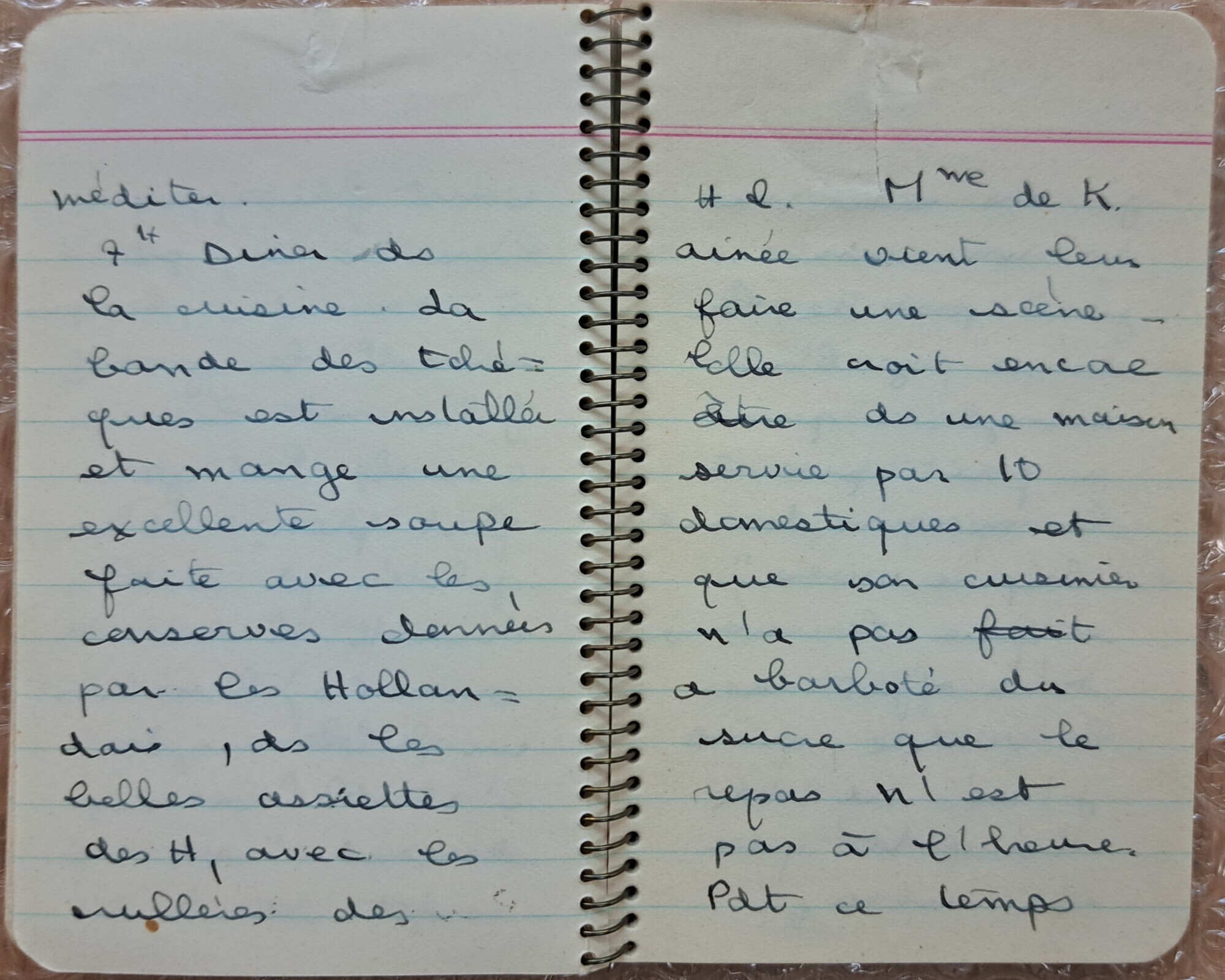
Four o'clock, supper in the galley. The group of Czechs is settled in, and we eat an excellent soup made from tins donated by the Dutch, served in the H.[Hamburger family]'s beautiful plates, with the H.[Hamburger family]'s spoons. Mrs de K.[de Kadt] appears and creates a scene. She still believes herself to be in a house staffed by ten servants, that her cook has been pilfering the sugar and that meals should be served at their appointed time.
Meanwhile, I placed myself in a corner. I fetched soup and ate it, which prompted the sailors to say "Sapere vivere", and the cook offered me meat and I had tea, while the Dutch were poorly served. Afterwards the lady continued counting biscuits and personal belongings that we had found. To smile and help oneself is the motto of this boat.
The 25th [June]. The planks exuded a dampness mixed with bleach-water, which soaked into my berth, and tomorrow I risk being full of rheumatism. The boat is becoming ever damper. In the morning we are entitled to a slice of cheese and some jam. The Dutch lady reigns supreme and wants everything measured. The captain rose an hour later. The weather is bad. [There’s] wind. The barometer is rising. Perhaps we shall leave tomorrow. This morning I washed thoroughly in the captain's cabin while the ladies below received only enough water to wash the tips of their noses.
We give nothing to the Czechs. Yet they eat richly in the galley. Yesterday I spoke with a young Czech woman, strong and healthy. She told me about her Czech fiancé. They were supposed to marry, but she has had no news of him for fifteen days; he will be shot if captured. She said to me: "I was always so happy, I loved sport, he did too. We used to go into the mountains together and now I am on this boat with no news. I write to him care of poste restante in the Pyrenees and in Morocco, because I learned that the Czech army was sent there." She is twenty years old and we laugh about the mentality of the H[ollanders].
As for the young Pole, he remained on the boat last night. His girlfriend works in food distribution. She left with the refugees during the Spanish war and has now returned. He told me: "She became a refugee like yourselves, and your Dutch friend must be crying a great deal. Every man in turn becomes the guardian of the lavatory. He is required to stand watch. I volunteered three times to become a soldier, but was refused; yet for that sort of service, they will accept you.["]
Eleven o'clock. A glance from the deck. My fifty francs have turned into four kilograms of oranges and some dry brown biscuits in a sack, and they are good. I said "molto gracio" and offered a biscuit, asking for no account. The shaving soap has arrived, but it looks miserable. People are trying to buy bottles of mineral water. They ask the price I advance. Once again we encounter a wall of ignorance and distrust. This morning there is a little sunshine. The deck is covered with sawdust. The carpenter, wearing a checked shirt and a handsome smile, is sawing planks. The deck is never washed. White cap (the lavatory captain) and his French wife in a leopard-skin coat (she wished to travel only first class) have a rheumatic and helpless appearance. The Czechs grow fat, how? And create a great deal of disorder: rolled-up and torn silk stockings, beards and dirt, yet they seem happy. The steward runs from the hold to the galley, thin but interesting. Some unfamiliar faces, a fur coat and a green complexion, wander about melancholically. It is the old Dutch guard.
A Dutch gentleman, a banker in a navy-blue suit with a delightful royal-blue spotted handkerchief, who sleeps in the galley, possesses a pantry full of delicatessen (yesterday I tasted his plums), and smokes a cigar. The sawyer whistles impatiently. The spy in the green scarf that matches her complexion and is surrounded by her tousle-haired, barefoot children. Mummy arrives. The steward criticises me for buying oranges. Mummy defends me, saying we have no reserves (we were told that the captain would provide food on board) and everyone else has a secret store of milk and fruit. Grand Historia [?] tells me that my nihilistic scribbling [...] "impossibility of leaving by train." Long live oranges. The steward's superintendent (my cousin) hangs clothes out to wash and dry on a line. I advise her to beware of the smoke coming from the funnel. The clothes risk becoming dirty.
Ada arrives wearing the red scarf. It appears that we are famous. The B[elgian] and D[utch] capitalists who paid a million to charter the boat [...]. We are in the local newspapers and de Kadt has been interviewed. "A suffering heart," he tells me, "the white slave trade", while looking at my red sealskin handbag.
"The galley Milena, of 773 tons and registered in Lisbon, entered the harbour. On board are travelling Belgian and Dutch capitalists. The cost of the voyage exceeds one million francs." La Gaceta del Norte (25th June 1940).
Seven o'clock. We have become an object of curiosity in the harbour. Two new soldiers have come to see us. A small boat carrying two boys circles the vessel. The red-haired girl is ill. The doctor came. He says: "Today a little fish, tomorrow a little meat."